
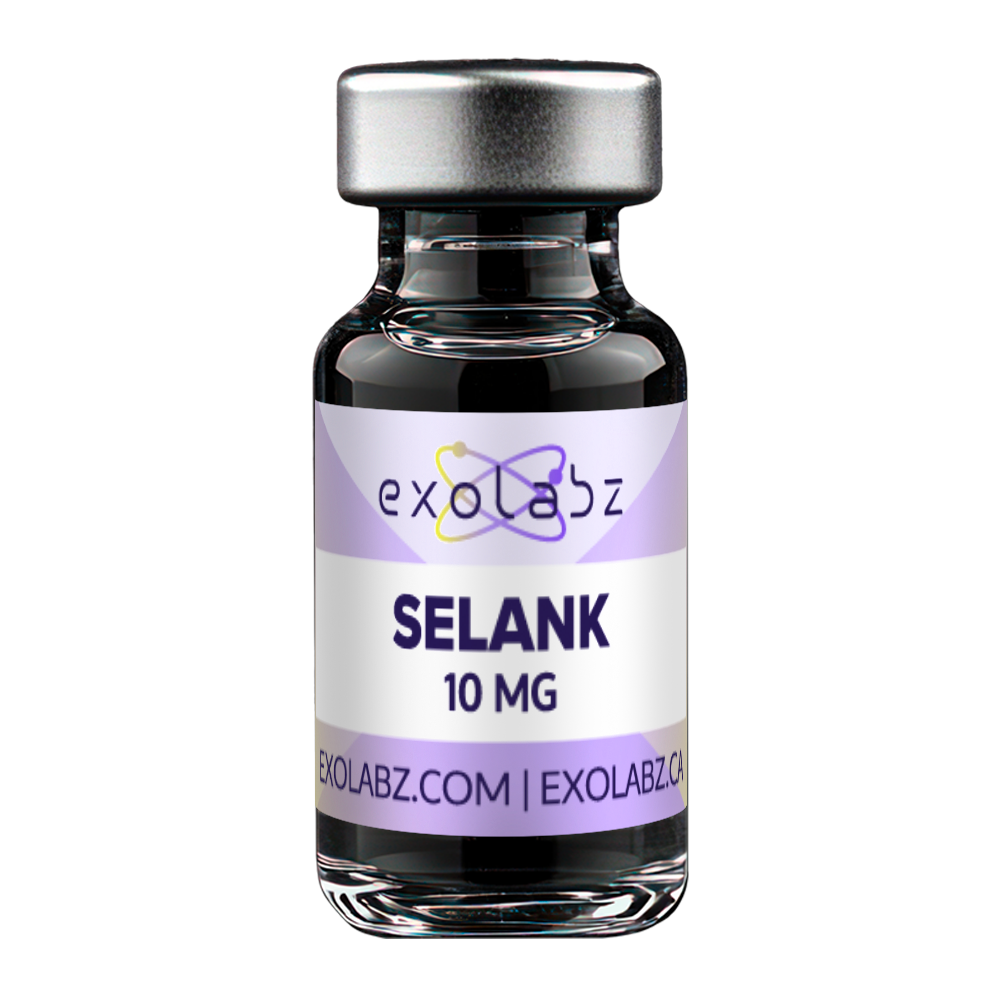
Description
SELANK 10mg – Research-Grade Peptide for Neuroscience and Peptide Signaling Studies
Delivery: Laboratory Research-Grade, 10mg Vial
Other sizes. The same compound is also supplied as a 5mg vial.
SELANK 10mg is a synthetic peptide analog of tuftsin, intended exclusively for laboratory research applications. SELANK is referenced in scientific literature for studies involving peptide signaling, neuronal pathways, and molecular neuroscience research.
This product is strictly for research purposes only and is not approved for human consumption, clinical use, or veterinary applications.
What Is SELANK?
SELANK is a synthetic derivative of tuftsin designed for in vitro and preclinical laboratory studies. It is utilized in controlled research environments to investigate:
• Peptide-receptor interactions in neuronal models
• Cellular signaling pathways in CNS tissue or culture models
• Neurochemical modulation and molecular responses
• Mechanistic studies of synthetic neuropeptides
All research uses are limited to laboratory models and non-clinical studies.
Research Applications of SELANK 10mg
SELANK 10mg is suitable for laboratory investigations focusing on:
• Neuroscience & Peptide Signaling Research – Analysis of neuronal peptide interactions and pathways
• Neuropeptide & Molecular Research – Mechanistic studies of tuftsin analogs in cellular models
• Experimental Neurobiology Studies – Investigating signaling pathways in vitro or ex vivo
• Biochemical and Molecular Pathway Analysis – Studies on receptor-mediated responses and cellular signaling
• Laboratory Peptide Research – Controlled experiments with synthetic neuropeptides
All applications are strictly for scientific investigation and non-clinical research only.
Product Specifications
• Peptide: SELANK
• Sequence: Synthetic tuftsin analog
• Concentration: 10mg per vial
• Grade: Research-Grade
• Storage: Maintain according to standard peptide laboratory protocols
The 10mg format allows flexible experimental design for multi-phase studies or high-volume laboratory protocols.
Purity & Quality Assurance
ExoLabz peptides are produced under rigorous quality control standards. Each SELANK 10mg batch undergoes independent third-party testing to verify identity, purity, and concentration accuracy. Researchers may submit the peptide for verification. If specifications are not met, ExoLabz provides a refund and testing reimbursement to ensure research integrity.
Important Legal Disclaimer
For Research Purposes Only
SELANK 10mg is intended strictly for laboratory research and scientific investigation. It is not approved by Health Canada, FDA, or any other regulatory authority. This product is not for human consumption, medical, or veterinary use. By purchasing, you agree to use it exclusively for lawful laboratory research purposes.
Compound identity and specification
Identity data for Selank, published so the material can be checked against an independent record rather than taken on trust. The formula, mass and registry number below are verified against PubChem and can be looked up directly.
| Compound | Selank |
|---|---|
| Sequence | Thr-Lys-Pro-Arg-Pro-Gly-Pro (TKPRPGP) |
| Molecular formula | C33H57N11O9 |
| Molecular mass | 751.9 g/mol |
| CAS registry number | 129954-34-3 |
| PubChem | CID 11765600 |
| Vial content | 10 mg |
| Physical form | Lyophilised powder in a sealed vial |
| Analysis | Third-party HPLC; the result for this product is published on this page |
| Supplied for | Laboratory research use only |
Analytical note — Selank. Three of seven residues are proline, which produces conformational peak broadening, and the lysine and arginine make the peptide strongly basic with no acidic residue to offset them. Ion-pairing additive in the mobile phase is doing real work on this one.
Identity references The molecular formula, molecular mass and CAS registry number above are taken from the PubChem record linked in the table, not from a supplier datasheet, so every figure can be checked against an independent source in one click. Sequences are given as reported in the peptide literature, in the one-letter or three-letter convention as appropriate, with any non-standard residue named in full. Where a compound exists in more than one form — a free peptide and a metal complex, a fragment and its parent protein, a modified and an unmodified analog — the form supplied is the one identified here, and the mass on the certificate of analysis is what distinguishes it.
Research Literature
Peer-reviewed studies involving this compound and its class. All findings listed are from in vitro, cell culture or animal models and are provided for scientific reference only. This product is supplied for laboratory research and is not approved for human consumption, clinical, or veterinary use.
- Semenova TP, et al. Eksp Klin Farmakol. 2009;72(4):6-8. In male Wistar rats pretreated with the serotonin synthesis inhibitor PCPA, measured serotonin turnover in brainstem and neocortex. Source · PMID 19803361
- Kolomin T, et al. Regul Pept. 2011;170(1-3):18-23. In mouse spleen, measured expression of inflammation-related genes following administration. Source · PMID 21609736
- Volkova A, et al. Front Pharmacol. 2016;7:31. In rat frontal cortex, measured expression of 84 GABAergic and neurotransmission-related genes 1-3 hours after administration, against diazepam. Source · PMID 26924987
The third-party report for this material is published on this page, and every certificate we hold is collected on the certificates of analysis page.
Related Research Compounds
Browse more compounds in Neuropeptides, or view the full research peptide catalogue.

Reviews
There are no reviews yet.