
Copper Peptides
Copper peptides are a small and unusual category: the research subject is not a peptide alone but a metal complex, and that distinction drives everything about how the material is identified, handled and analysed. Supplied as lyophilised powder for laboratory research use only.
The free peptide and the complex are different substances
GHK is a tripeptide — glycyl-L-histidyl-L-lysine, C14H24N6O4, 340.38 g/mol, CAS 49557-75-7. GHK-Cu is that tripeptide coordinated to copper(II) — C14H23CuN6O4, about 402.92 g/mol, CAS 89030-95-5, the registry number for copper tripeptide-1.
The two CAS numbers are frequently used interchangeably in supplier listings, and they should not be: one describes an organic tripeptide and the other a coordination compound roughly 62 Da heavier. Anyone comparing certificates should check which registry number and which mass a document reports, because a certificate for the free peptide says nothing about whether copper is present or bound.
Why coordination chemistry matters analytically
The copper is held by the imidazole nitrogen of the histidine side chain, the terminal amine and a backbone nitrogen. That has consequences an ordinary peptide does not have:
- The complex has a visible absorption band, which is why GHK-Cu material is blue rather than white. Colour is therefore a crude but real indicator, and an off-colour or patchy cake is worth photographing on arrival.
- Copper complexes behave differently on a reverse-phase column than the free peptide, so a chromatogram of one is not comparable to a chromatogram of the other.
- Copper is redox active, which makes the complex more sensitive to conditions that would leave a plain tripeptide alone.
- Mass spectrometry of a metal complex shows the copper isotope pattern, which is a useful confirmation that the metal is actually present rather than assumed.
Our note on GHK-Cu and copper coordination covers this in more detail, and reading an HPLC chromatogram covers what to look for in the trace.
In this category
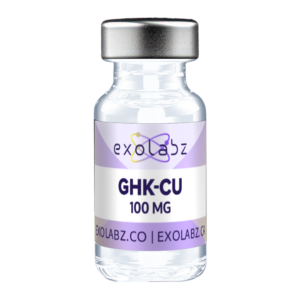
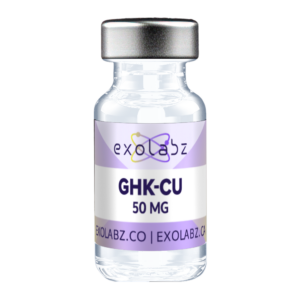
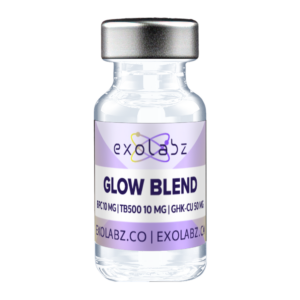
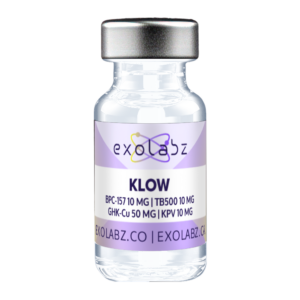
GHK-Cu in 50 mg and 100 mg vials. GHK-Cu is also a component of the larger multi-peptide blends — it is the 50 mg component in both GLOW and KLOW, which is worth knowing when comparing a blend’s price against a single-compound vial.
Analysis and handling
Certificates of analysis are published per product, with batch photographs for matching. Because copper is redox active, storage discipline matters more here than for a plain tripeptide — see how peptides degrade.
Supplied for laboratory research use only. Not authorised by Health Canada or the FDA; no DIN or NPN; not manufactured to pharmaceutical GMP standards; not for human or veterinary use.
Showing all 4 results
-
 View product
Copper Peptides
View product
Copper PeptidesGHK-Cu Copper Peptide 100mg
Price range: $78.74 through $104.99 -
 View product
Copper Peptides
View product
Copper PeptidesGHK-Cu Copper Peptide 50mg
Price range: $44.99 through $59.99 -
Sold Out
 View details
BPC-157 & TB-500 Peptides
View details
BPC-157 & TB-500 PeptidesGLOW Peptide Blend 70mg
Price range: $127.49 through $169.99 -
 View product
BPC-157 & TB-500 Peptides
View product
BPC-157 & TB-500 PeptidesKLOW Peptide Blend 80mg
Price range: $127.49 through $169.99
Copper Peptides compared
| Compound | Vial | Price 1 vial | Per mg | Relative cost per mg | Per mg at 10+ | Status |
|---|---|---|---|---|---|---|
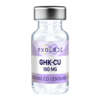 GHK-Cu Copper Peptide 100mgCopper Peptides GHK-Cu Copper Peptide 100mgCopper Peptides | 100 mg | $104.99 | $1.05 | $0.79 | In stock | |
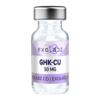 GHK-Cu Copper Peptide 50mgCopper Peptides GHK-Cu Copper Peptide 50mgCopper Peptides | 50 mg | $59.99 | $1.20 | $0.90 | In stock | |
 GLOW Peptide Blend 70mgBPC-157 & TB-500 Peptides GLOW Peptide Blend 70mgBPC-157 & TB-500 Peptides | 70 mg | $169.99 | $2.43 | $1.82 | Restocking | |
 KLOW Peptide Blend 80mgBPC-157 & TB-500 Peptides KLOW Peptide Blend 80mgBPC-157 & TB-500 Peptides | 80 mg | $169.99 | $2.12 | $1.59 | In stock |
Prices in CAD for the quantity selected above. Bulk pricing applies automatically in the cart: 5% off 2 to 5 vials, 10% off 6 to 7, 15% off 8 to 9 and 25% off 10 or more, the same tiers shown on every product page. All products are for laboratory research use only.
Built for Canadian labs that check the data
Packed and handed to the carrier usually within one business day, then tracked across Canada, typically 1 to 4 business days outside the territories.
Independent laboratories run the HPLC and purity work. Certificates live on the certificates page and on selected product pages, and cap and crimp colour ties a vial to its document.
Test a vial yourself. If an independent laboratory reports a purity failure, the product is refunded and the cost of that test comes back with it.
Free over $200 CAD, with no clearance, duty or brokerage anywhere in the country, and quantity pricing applied in the cart.
Email and live chat reach someone who knows the catalogue, with replies in about an hour, day or night.
Encrypted payment in Canadian dollars, plain protective packaging, and parcels released only to the named purchaser.
From cart to bench in four steps
- 01Choose your compounds
Check identity data and certificates before you order.
- 02Secure checkout
Encrypted payment, with quantity discounts applied in the cart.
- 03Packed and dispatched
Usually within 1 business day, with tracking emailed as it leaves.
- 04Delivered
A domestic parcel, 1 to 4 business days across the provinces.
5.0 out of 5 from 25 reviews
Very happy with short wait time to get the product. Simple label to read.
Quick packaging and shipping !
Have tried other suppliers. Exolabz is hands down the best at communication and ease of ordering and tracking my order
Research-grade compounds, shipped from inside Canada.
Free tracked shipping over $200, dispatch usually within 1 business day, and third-party HPLC and purity testing.
 BPC-157 10mg
 NAD+ 1000mg
 MOTS-c 10mg
 Selank 10mg