
Description
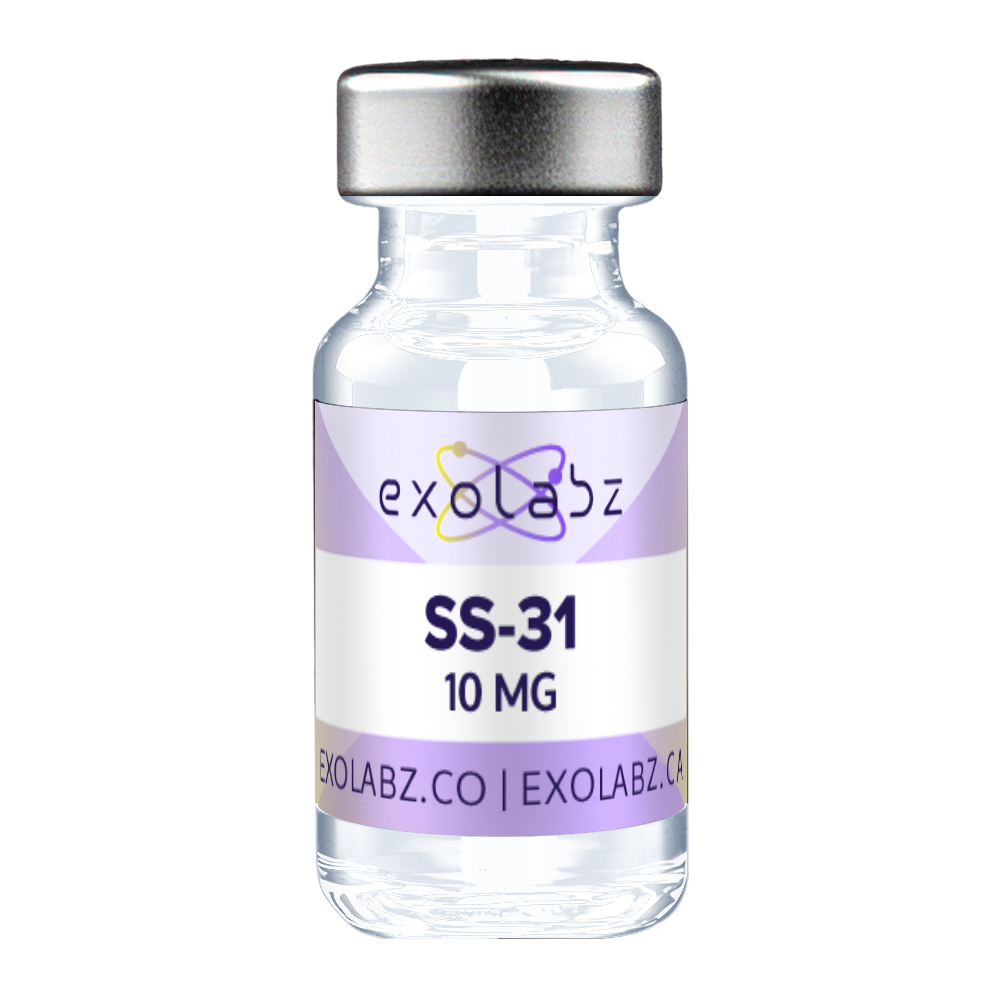
SS-31 (Elamipretide) 10mg – Mitochondria-Targeted Tetrapeptide
SS-31, also known as elamipretide, is a four-residue peptide: D-Arg–Dmt–Lys–Phe–NH2, where Dmt is 2′,6′-dimethyltyrosine. It belongs to the Szeto-Schiller (SS) series, peptides first made as opioid ligands and later found to concentrate in mitochondria. It is studied as a tool for asking how a small, positively charged peptide crosses membranes and interacts with cardiolipin, the lipid that defines the inner mitochondrial membrane.
SS-31 10mg is supplied as lyophilised powder at 99%+ purity for in vitro and laboratory research. It is not approved for human or veterinary use.
Why the sequence looks the way it does
The SS peptides alternate aromatic and basic residues. At physiological pH SS-31 carries a net charge of +3, from the arginine, the lysine and the free N-terminal amine. That charge would normally keep a peptide out of cells. Zhao et al. (2004) nonetheless showed that SS peptides enter cells and accumulate at the inner mitochondrial membrane despite their charge.
- D-arginine at position 1 makes the N-terminus resistant to aminopeptidases, which would otherwise shorten a four-residue peptide almost immediately.
- Dmt at position 2 adds two methyl groups to the tyrosine ring. The ring’s phenolic group is also a scavenger of reactive oxygen species in vitro.
- The C-terminal amide removes a negative charge and protects against carboxypeptidases.
What the literature measures
The central mechanistic claim is binding to cardiolipin. Birk et al. (2013) reported that SS-31 interacts with cardiolipin and, through it, with the cytochrome c–cardiolipin complex, measured in isolated mitochondria and model membranes. Mitchell et al. (2020) widened the picture, using biophysical methods to show that SS-31 binds lipid bilayers generally and changes their surface electrostatics, not only through a one-to-one interaction with cardiolipin. Szeto’s 2014 review sets out the case for cardiolipin as the target and summarises the preclinical models used.
For a researcher, the open question those papers leave is specificity: how much of the observed behaviour comes from cardiolipin binding and how much from general membrane-surface effects. Model membranes with and without cardiolipin are the usual way to separate them.
Working with it in the lab
- Identity is easy; stereochemistry is not. At about 640 g/mol, SS-31’s mass is quick to confirm. But an L-arginine epimer has exactly the same mass, so mass spectrometry cannot tell them apart. Separating D/L forms needs a chiral method or a reference standard.
- Counter-ion and net content. A small, highly charged peptide carries a large share of counter-ion (acetate or trifluoroacetate) by weight. The peptide content of a 10 mg vial is therefore noticeably below 10 mg of free base. Our note on net peptide content explains the arithmetic.
- Solubility. The charge makes SS-31 readily water-soluble, and it tends to stick to glass and some plastics at low concentrations. Low-binding tubes reduce losses in dilute working solutions.
- Storage. Keep the lyophilised powder sealed, dry and cold, and store reconstituted solutions as single-use aliquots.
Questions researchers ask
Is SS-31 the same as elamipretide? Yes. SS-31 is the original laboratory name; elamipretide is the international non-proprietary name for the same sequence.
How does it differ from MOTS-c? MOTS-c is a 16-residue peptide encoded in mitochondrial DNA and studied as a signalling molecule. SS-31 is a synthetic tetrapeptide designed to reach the mitochondrial membrane. They are different molecules asking different questions.
What should the certificate show? An intact mass matching about 640 g/mol, an HPLC purity figure, and ideally the counter-ion, since it changes how much peptide the vial holds.
Specifications
- 10 mg lyophilised peptide per vial
- Third-party HPLC for identity and purity, with the report published on this page
- Batch-level verification
- Dispatched from within Canada
Purity and quality assurance
ExoLabz products undergo independent third-party testing to verify peptide identity and purity, and results are published on this site. Researchers may run their own analytical verification. If validated testing confirms a purity discrepancy, ExoLabz provides a refund and testing reimbursement in line with company policy.
For research purposes only
SS-31 10mg is supplied strictly for laboratory research and analytical use. It is not intended for human consumption, veterinary use, clinical research involving human subjects, therapeutic use or diagnostic applications. It has not been evaluated or approved by Health Canada for any use. By purchasing, the buyer confirms the material will be handled only by qualified professionals and used solely for lawful laboratory research.
Compound identity and specification
Identity data for SS-31 (elamipretide), published so the material can be checked against an independent record rather than taken on trust. The formula, mass and registry number below are verified against PubChem and can be looked up directly.
| Compound | SS-31 (elamipretide) |
|---|---|
| Sequence | D-Arg-Dmt-Lys-Phe-NH2 |
| Molecular formula | C32H49N9O5 |
| Molecular mass | 639.8 g/mol |
| CAS registry number | 736992-21-5 |
| PubChem | CID 11764719 |
| Vial content | 10 mg |
| Physical form | Lyophilised powder in a sealed vial |
| Analysis | Third-party HPLC; the result for this product is published on this page |
| Supplied for | Laboratory research use only |
Analytical note — SS-31 (elamipretide). A four-residue peptide containing a D-arginine and 2,6-dimethyltyrosine, a non-standard residue. It is strongly basic and small, so retention depends heavily on ion-pairing additive, and the non-standard residues mean routine amino-acid analysis will not match a standard reference table.
Identity references The molecular formula, molecular mass and CAS registry number above are taken from the PubChem record linked in the table, not from a supplier datasheet, so every figure can be checked against an independent source in one click. Sequences are given as reported in the peptide literature, in the one-letter or three-letter convention as appropriate, with any non-standard residue named in full. Where a compound exists in more than one form — a free peptide and a metal complex, a fragment and its parent protein, a modified and an unmodified analog — the form supplied is the one identified here, and the mass on the certificate of analysis is what distinguishes it.
Research Literature
Peer-reviewed studies involving this compound and its class. All findings listed are from in vitro, cell culture or animal models and are provided for scientific reference only. This product is supplied for laboratory research and is not approved for human consumption, clinical, or veterinary use.
- Zhao K, et al. J Biol Chem. 2004;279(33):34682-34690. In neuronal cells and isolated mitochondria, measured intracellular ROS, mitochondrial swelling and membrane depolarisation at nanomolar concentrations. Source · PMID 15178689
- Birk AV, et al. J Am Soc Nephrol. 2013;24(8):1250-1261. In ischaemic rat kidney, measured high-affinity cardiolipin binding, inhibition of cytochrome c peroxidase activity and cristae ultrastructure. Source · PMID 23813215
- Mitchell W, et al. J Biol Chem. 2020;295(21):7452-7469. In model membranes and isolated mitochondria, measured interfacial partitioning as a function of bilayer surface charge, lipid packing and surface electrostatics. Source · PMID 32273339
The third-party report for this material is published on this page, and every certificate we hold is collected on the certificates of analysis page.
Related Research Compounds
Browse more compounds in Mitochondrial & Cellular Compounds, or view the full research peptide catalogue.
 BPC-157 10mg
 NAD+ 1000mg
 MOTS-c 10mg
 Selank 10mg
Reviews
No reviews for this product yet. Here is what customers say about ExoLabz.