
Description
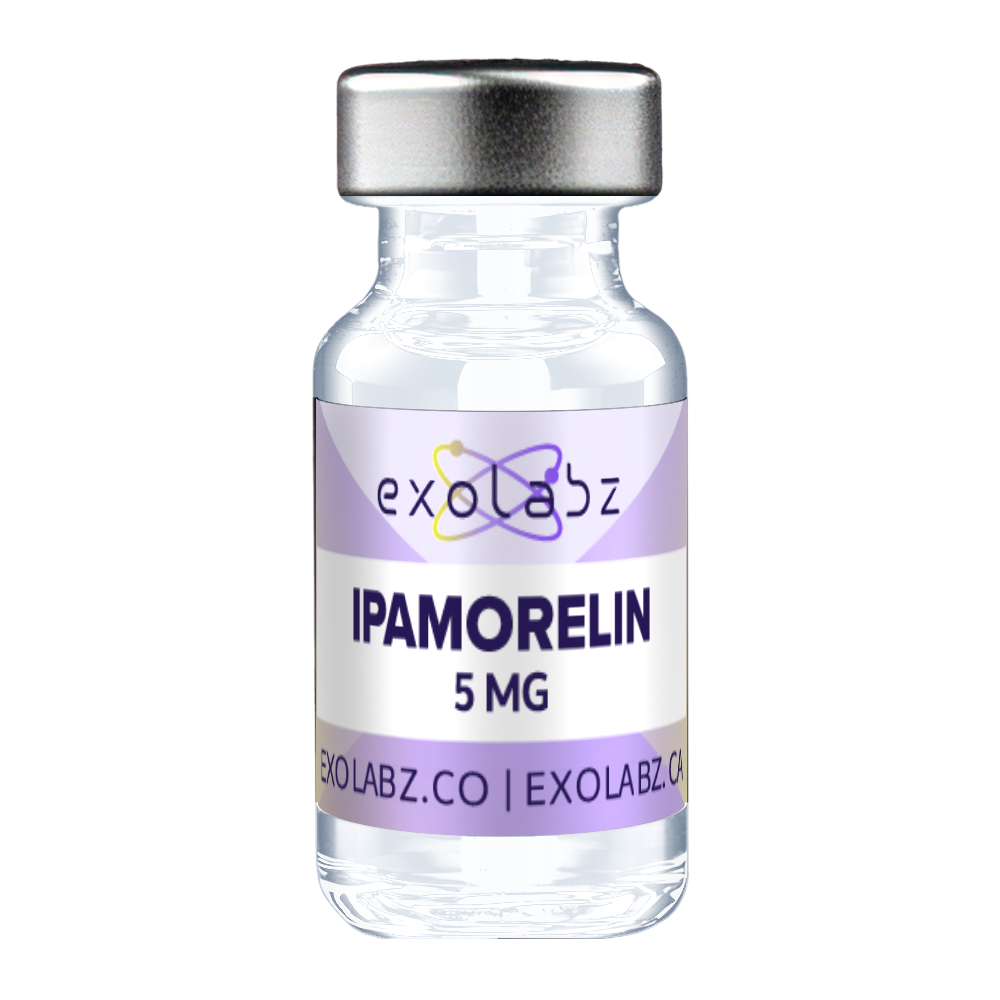
Ipamorelin 5mg – Research-Grade Peptide for Ghrelin Receptor and Growth Hormone Signaling Studies
Delivery: Laboratory Research-Grade, 5mg Vial Supplied at 99%+ purity.
Other sizes. The same compound is also supplied as a 10mg vial, and blended with CJC-1295 in a two-peptide vial.
Ipamorelin 5mg is a synthetic, research-grade peptide developed for advanced laboratory investigations involving ghrelin receptor signaling, peptide–receptor interactions, and endocrine pathway research. It is commonly used in controlled scientific environments studying growth hormone secretagogue receptor (GHSR) activity, peptide pharmacology, and molecular signaling pathways.
This product is strictly intended for research purposes only and is not approved for human consumption, clinical, or veterinary use.
What Is Ipamorelin?
Ipamorelin is a synthetic peptide classified as a growth hormone secretagogue receptor (GHSR) agonist. In laboratory settings, Ipamorelin is used to investigate mechanisms related to ghrelin receptor signaling and peptide interaction with endocrine pathways.
Researchers study Ipamorelin in experimental models to explore:
• Peptide–receptor binding and signaling mechanisms
• Ghrelin receptor (GHSR) activation in controlled laboratory systems
• Endocrine signaling pathways involving peptide mediators
• Peptide structure, stability, and molecular characterization
• Experimental peptide biology and receptor pathway research
All applications are strictly non-clinical and limited to scientific laboratory investigation.
Research Applications of Ipamorelin 5mg
Ipamorelin 5mg is suitable for laboratory research including:
• Ghrelin Receptor Signaling Studies – Investigation of GHSR-mediated signaling pathways
• Endocrine Pathway Research – Laboratory studies examining peptide interactions with hormone signaling systems
• Peptide Pharmacology & Molecular Biology – Controlled research involving synthetic peptide compounds
• Receptor Binding and Mechanistic Studies – Analysis of peptide–receptor activity in experimental models
• Laboratory Peptide Research – In vitro or ex vivo peptide investigation under controlled scientific conditions
All uses are restricted to scientific research purposes only.
Product Specifications
• Peptide: Ipamorelin
• Concentration: 5mg per vial
• Grade: Research-Grade
• Storage: Store according to standard peptide laboratory protocols
The 5mg format provides flexibility for small-scale laboratory experiments, pilot studies, and controlled peptide research protocols.
Purity & Quality Assurance
ExoLabz peptides are produced under strict quality control standards. ExoLabz products undergo independent third‑party testing to verify identity, purity, and composition. Results are published on this site.
Researchers may independently submit the product for verification. If specifications are not met, ExoLabz provides a refund and testing reimbursement, ensuring full transparency and research integrity.
Important Legal Disclaimer
For Research Purposes Only
Ipamorelin 5mg is intended strictly for scientific research and laboratory investigation. It is not approved by the FDA, Health Canada, or any other regulatory authority. This product is not for human consumption, clinical, therapeutic, or veterinary use.
By purchasing this product, the buyer acknowledges and agrees that it will be used exclusively for lawful laboratory research purposes.
Compound identity and specification
Identity data for Ipamorelin, published so the material can be checked against an independent record rather than taken on trust. The formula, mass and registry number below are verified against PubChem and can be looked up directly.
| Compound | Ipamorelin |
|---|---|
| Sequence | Aib-His-D-2-Nal-D-Phe-Lys-NH2 |
| Molecular formula | C38H49N9O5 |
| Molecular mass | 711.9 g/mol |
| CAS registry number | 170851-70-4 |
| PubChem | CID 9831659 |
| Vial content | 5 mg |
| Physical form | Lyophilised powder in a sealed vial |
| Analysis | Third-party HPLC; the result for this product is published on this page |
| Supplied for | Laboratory research use only |
Analytical note — Ipamorelin. Three of the five residues are non-standard: alpha-aminoisobutyric acid, D-2-naphthylalanine and D-phenylalanine. Amino-acid analysis after hydrolysis cannot distinguish D from L, so composition analysis alone does not confirm this sequence; identity rests on mass and on the synthesis route.
Identity references The molecular formula, molecular mass and CAS registry number above are taken from the PubChem record linked in the table, not from a supplier datasheet, so every figure can be checked against an independent source in one click. Sequences are given as reported in the peptide literature, in the one-letter or three-letter convention as appropriate, with any non-standard residue named in full. Where a compound exists in more than one form — a free peptide and a metal complex, a fragment and its parent protein, a modified and an unmodified analog — the form supplied is the one identified here, and the mass on the certificate of analysis is what distinguishes it.
Research Literature
Peer-reviewed studies involving this compound and its class. All findings listed are from in vitro, cell culture or animal models and are provided for scientific reference only. This product is supplied for laboratory research and is not approved for human consumption, clinical, or veterinary use.
- Raun K, et al. Eur J Endocrinol. 1998;139(5):552-561. In primary rat pituitary cell culture, anaesthetised rats and conscious swine, measured GH release and the absence of concomitant ACTH and cortisol elevation. Source · PMID 9849822
- Johansen PB, et al. Growth Horm IGF Res. 1999;9(2):106-113. In rats, measured longitudinal bone growth following administration. Source · PMID 10373343
- Svensson J, et al. J Endocrinol. 2000;165(3):569-577. In adult female rats, characterised the response to chronic secretagogue exposure; see the linked record for endpoints. Source · PMID 10828840
The third-party report for this material is published on this page, and every certificate we hold is collected on the certificates of analysis page.
Related Research Compounds
Browse more compounds in GHS, or view the full research peptide catalogue.

 BPC-157 10mg
 NAD+ 1000mg
 Selank 10mg
Reviews
No reviews for this product yet. Here is what customers say about ExoLabz.